Lori Malahy
Title: Muzzle for the Unruly
Artist: Lori Malahy
Materials: Micaceous clay, smoke-fired, paper
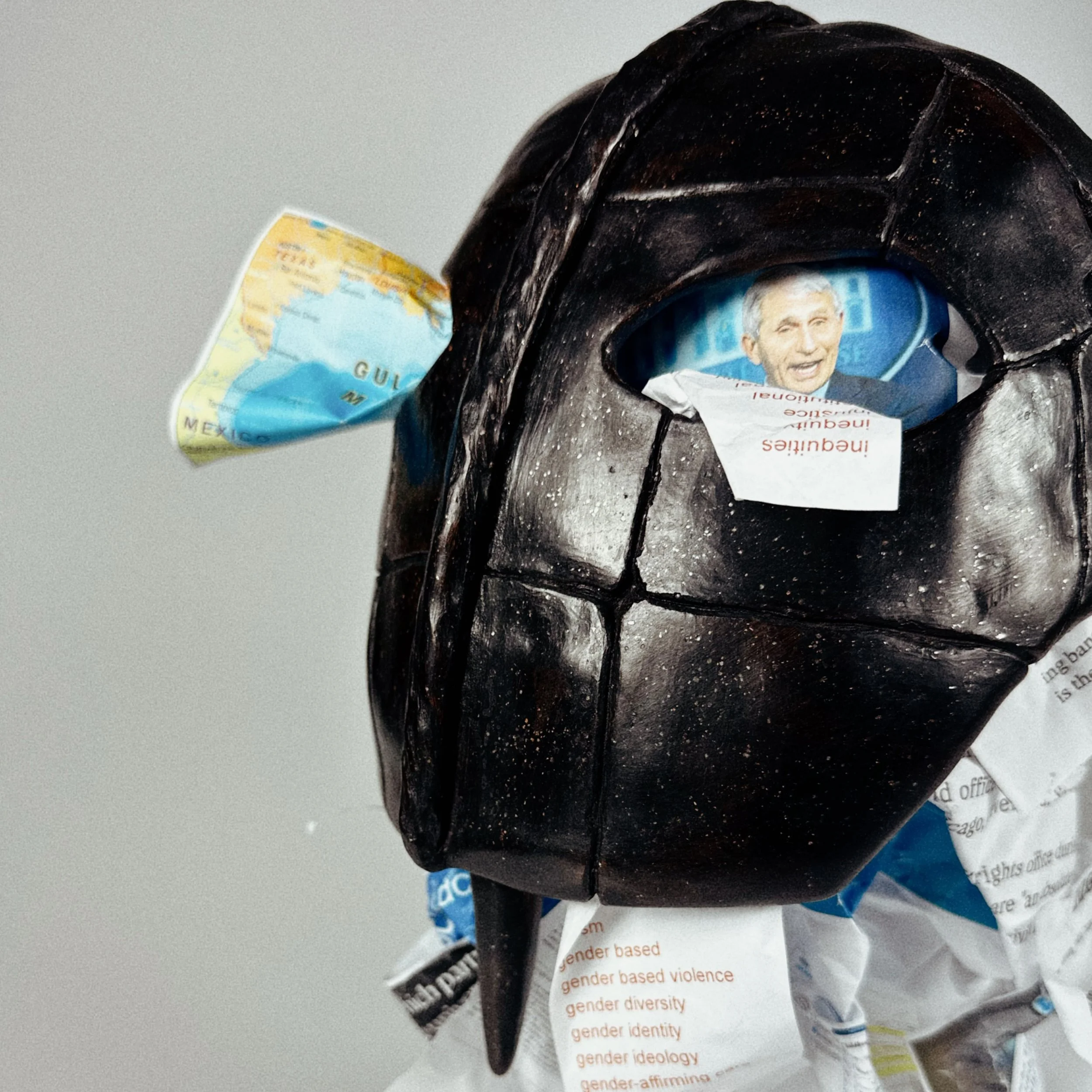
Muzzle for the Unruly is a sculptural reimagining of the Scold’s Bridle, an iron instrument of torture and public humiliation used primarily in 16th- through 19th-century. Designed to silence women labeled as "scolds"—those accused of gossiping, slandering, or challenging male authority—the device featured a metal "bit" or spike that was inserted into the mouth to painfully pin the tongue. Beyond preventing speech, in a way, this tool forcibly reconstructed a woman’s social identity, marking her as "unruly" and subordinating her voice to the communal and patriarchal order.
While the scold’s bridle has (thankfully) faded into obsolescence, the impulse to silence dissenting voices remains pervasive. The artist sees elements of this historical muzzle in the "chilling effects" found in modern society. In this age of identity politics, while women are no longer forced into these barbaric iron devices, marginalized voices often face a modern version of public shaming intended to dismantle their credibility and push them into self-censorship — where digital harassment, doxing, and systemic or societal censorship act as invisible bits and bridles. Muzzle for the Unruly asks us to consider: whose voices are we still trying to pin down, and what modern materials have replaced the iron of the past?
This contemporary interpretation is hand-built from micaceous clay, a material known for its high mica content, which imbues the surface with a subtle, metallic shimmer. After a low temperature bisque, this piece was blackened to create a dark finish that highlights the mica and the fractures built into the sculpture. Micaceous clay, typically associated with traditional cookery by indigenous peoples across the Americas and others worldwide, is here transformed into a darkened, somber, metallic cage. The heavy, braid-like coils that historically decorated the head now seem to strain against the pressure from within, and the singular, aggressive spike over the mouth area in this piece highlight the physical violence of the object, while the cracked, earthy texture suggests a relic unearthed from a difficult past.
The interior is packed tightly with crumpled papers that threaten to burst through the small eye and ear openings, and especially around the aggressive ceramic spike. The paper objects— pages from scientific journals (including articles written by the artist and pages of her dissertation), maps, and redacted websites and internal memos—are chaotic and illegible as individuals but overwhelming as a collective mass. Words on the crumpled paper balls include "CLIMATE CHANGE," "EQUALITY," "TRANSGENDER," "GULF OF MEXICO," and "WOMEN." Other balls include names of silenced public figures or individuals detained or deported by ICE, alongside organization identifiers like "CDC" and "EPA," each crumpled and constrained, symbolizing a current effort to physically and intellectually silence and remove the concepts or figures.
Artist Bio and Muzzle for the Unruly Approach
Drawing on a PhD in Social Psychology from the University of Washington, Lori Malahy’s research practice is rooted in the study of social identity and the mechanics of bias and discrimination. Her professional career has centered on research supporting the safety and well-being of vulnerable populations, especially within the social context—a background that deeply informs her artistic inquiry.
At CCACA 2026, Malahy applies this analytical lens to the concept of "obsolete tools." She explores the physical legacy of oppression by examining historical objects used for both subjugation and psychological, physical, and societal oppression (in this case, the scold’s bridle). Her work questions the "obsolescence" of these tools, suggesting that while the devices may have changed, the fundamental human experiences and societal needs they represent remain urgent today.